
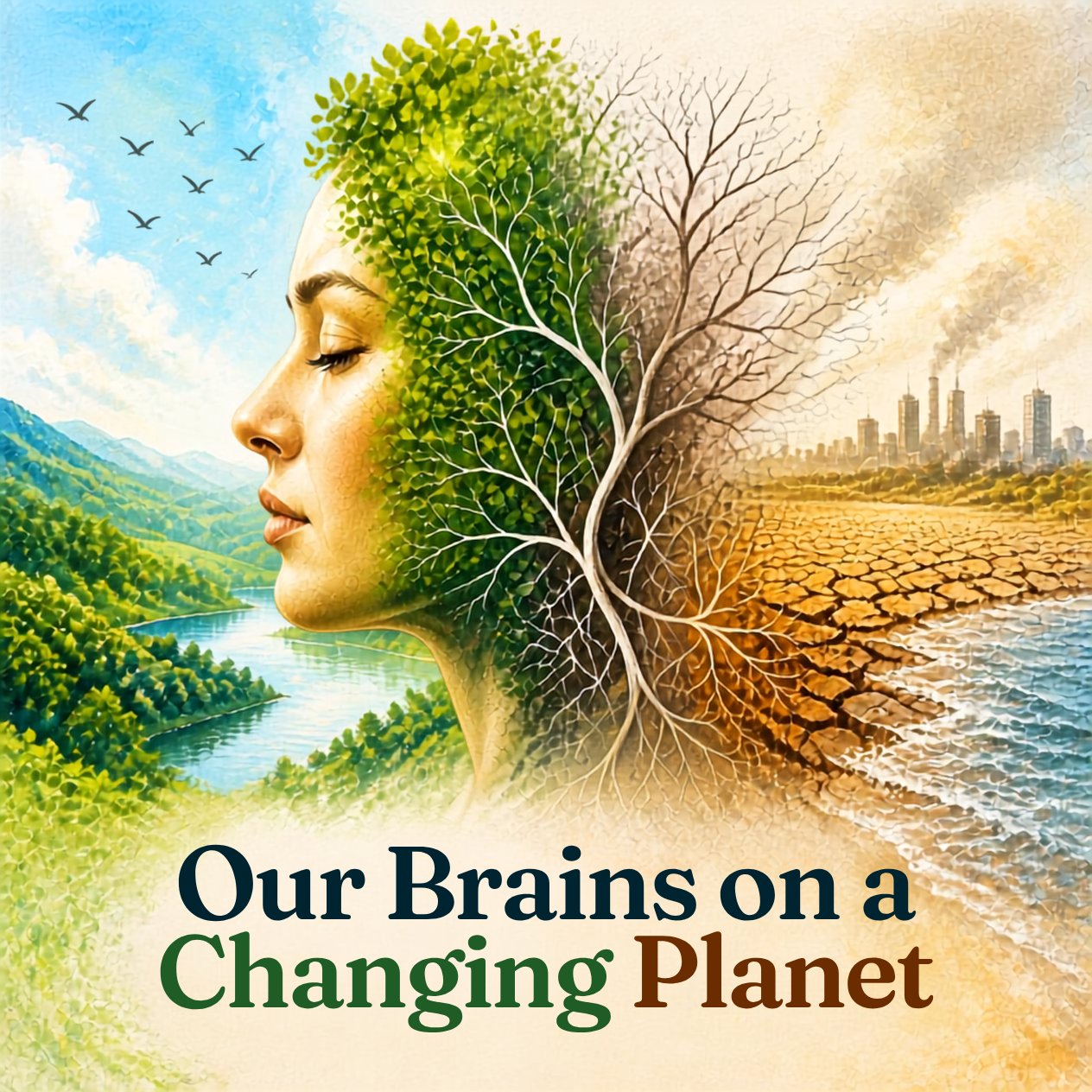
Our Brains on a Changing Planet
Climate, Brain Health & the Future of Human Resilience
Thursday, September 24, 2026 | 10:00 AM–12:00 PM
NYU School of Global Public Health | 708 Broadway, Room 801, New York City
Free and open to the public | Registration required
What happens to our brains when the planet changes around us?
Extreme heat, air pollution, disasters, and environmental disruption are already shaping how we think, feel, develop, and age. Yet the brain remains one of the most overlooked dimensions of the climate and planetary health conversation.
During New York Climate Week, join leading scientists, clinicians, public health experts, and community leaders for an accessible, solutions-focused conversation exploring what a changing planet means for our brains, and what we can do about it.
The event will mark the launch of the Neuro Climate Science & Policy Report, bringing its two central themes to life: the emerging evidence on how climate change and environmental disruption affect brain health across the life course, and a policy framework for prevention, resilience, and solutions.
Through a keynote and two global panels, speakers will bring perspectives from children’s health, neuroscience and brain aging, mental health, environmental exposures, Indigenous knowledge, community resilience, global health, and climate policy, moving the conversation from understanding the risks to protecting brain health in a changing world.
We will explore two big questions:
A Brain Under Pressure: What is a changing planet doing to us? How do extreme heat, air pollution, climate disasters, and other environmental exposures affect mental health, child development, cognition, neurological health, and brain aging—and who is most vulnerable?
Healthy Brains on a Healthy Planet: What can we do? How can climate action, cleaner air, healthier environments, stronger communities, Indigenous knowledge, and better policy protect people, brains, and the planet at the same time?
The conversation will move beyond documenting climate-related risks to ask what resilience looks like and how science can translate into meaningful action for individuals, communities, cities, and governments.
Program
10:00–10:05 AM | Welcome and Opening Remarks
Mark Jit, PhD — New York University
10:05–10:15 AM | Overview: Our Brains on a Changing Planet
Burcin Ikiz, PhD — Neuro Climate Working Group / Stanford University
Setting the stage for an emerging conversation at the intersection of climate, environment, and brain health, and introducing the Neuro Climate Science & Policy Report.
10:15–10:30 AM | Keynote: From Evidence to Action
Frederica Perera, DrPH, PhD — Columbia University
Air pollution, climate change & children's brain health
Drawing on decades of research into environmental exposures and children's health, Dr. Perera will explore what the science has taught us about the developing brain and how evidence can be translated into action to protect children and future generations.
10:35–11:05 AM | Panel I: A Brain Under Pressure — How Is a Changing Planet Affecting Us?
Climate change and environmental disruption can affect the brain at every stage of life. What are we learning about these connections, who may be most vulnerable, and where are the biggest questions still to answer?
Moderator: Cecilia Sorensen, MD — Columbia University
Panelists: Josefina Cruzat, PhD — Universidad Adolfo Ibáñez / BrainLat, Chile; Ozge Karadag, MD, PhD — Bahçeşehir University, Türkiye; Swathi Manchikanti — Natural Resources Defense Council; Yoko Nomura, PhD — Queens College / CUNY
11:05–11:10 AM | Brain-CLIMA Project Announcement
Diane Re, PhD — Columbia University
11:10–11:40 AM | Panel II: Healthy Brains on a Healthy Planet — What Can We Do?
Understanding the risks is only the beginning. How can we create environments, communities, and policies that protect brain health and help people thrive in a changing climate?
Moderator: Julianna Gwiszcz, PhD — George Mason University
Panelists: Sheryl Batchelor — Yiliyapinya Indigenous Corporation; Gary Belkin, MD, PhD — Columbia University / Billion Minds Institute; Manasi Kumar, PhD — New York University; Claudia Santos, PhD — University College London
11:40–11:55 AM | Audience Discussion & Q+A: From Science to Solutions
Moderator: Leyla McCurdy — American Public Health Association, Children's Environmental Health Committee
An open conversation with speakers and the audience about what protecting brain health in a changing climate actually looks like, where the greatest opportunities for prevention and resilience lie, and what researchers, policymakers, health systems, communities, funders, and individuals should be doing differently.
11:55 AM–12:00 PM | Closing: Where Do We Go From Here?
Burcin Ikiz, PhD — Neuro Climate Working Group / Stanford University
Speakers & Moderators
Sheryl Batchelor — Yiliyapinya Indigenous Corporation
Sheryl Batchelor is Founder and CEO of Yiliyapinya Indigenous Corporation and an Adjunct Professor at Queensland University of Technology. An Australian Aboriginal educator and leader with more than 30 years of experience, she works at the intersection of Indigenous knowledge, brain health, neuroplasticity, trauma-informed practice, education, and community wellbeing. Through Yiliyapinya, she advances culturally grounded approaches that place culture, relationship, Country, and community at the center of brain health and healing.
Gary Belkin, MD, PhD — Columbia University / Billion Minds Institute
Gary Belkin is a psychiatrist and Director of the Billion Minds Project at Columbia University and founder of the Billion Minds Institute. His work approaches mental health as a foundation for social resilience and sustainable societies, with a particular focus on integrating psychological resilience into climate action. He previously served as Executive Deputy Commissioner for Mental Hygiene at the New York City Department of Health and Mental Hygiene, where he helped lead the citywide ThriveNYC initiative. His current work includes developing community-based models for embedding psychological resilience within broader climate resilience efforts.
Josefina Cruzat, PhD — Universidad Adolfo Ibáñez / BrainLat
Josefina Cruzat is a neuroscientist at BrainLat, the Latin American Brain Health Institute at Universidad Adolfo Ibáñez in Chile. Trained in theoretical and computational neuroscience, neuropsychology, and behavioral neurology, her research examines brain aging through a multidimensional lens integrating neuroimaging, computational approaches, biomarkers, and the exposome. Her recent work investigates how environmental, social, biological, and contextual factors shape brain health and aging across diverse populations, particularly in Latin America. She contributes to international research examining the exposome of brain aging across countries.
Julianna Gwiszcz, MSSW, PhD — George Mason University
Julianna Gwiszcz is Associate Director of George Mason University's Institute for a Sustainable Earth, where she helps build transdisciplinary partnerships connecting research, innovation, learning, and action toward a just and sustainable world. She works closely with George Mason's Center for Climate Change Communication and the Medical Society Consortium on Climate and Health to strengthen communities of practice and translate climate and health knowledge into action.
Burcin Ikiz, PhD — Stanford University
Burcin Ikiz is a neuroscientist working at the intersection of brain health, climate change, and planetary resilience. She is Founder and Chair of the International Neuro Climate Working Group, a global multidisciplinary network advancing research, policy, education, and community action on climate change and brain health, and Founder and Director of EcoNeuro. She is an Adjunct Lecturer in Psychiatry at Stanford University and advises international organizations on environmental and brain health. Her work focuses on understanding how climate and environmental change affect the brain across the lifespan and translating emerging science into policy and practical solutions. She was named a 2025 Grist 50 climate leader.
Ozge Karadag, MD, PhD — Bahçeşehir University
Ozge Karadag is Professor of Public Health at BAU School of Medicine in Türkiye and worked at Columbia University's Earth Institute/ Climate School as a researcher (2019-2023) and teaching faculty (2026). Her work spans global health, health equity, and community mental health with strong links to climate change, migration, disaster preparedness, and resilience. As part of two Lancet Commissions related to climate change and health, her work brings particular attention to the experiences and adaptive capacities of populations living in vulnerable conditions.
Manasi Kumar, PhD — New York University Grossman School of Medicine
Manasi Kumar is Professor of Population Health at NYU Grossman School of Medicine and a clinical psychologist and psychotherapist specializing in global and public mental health. Her work focuses on developing and implementing mental health interventions for marginalized populations and translating evidence into policy and practice. Having lived and worked across India, the United Kingdom, and Kenya, she brings extensive experience in culturally diverse settings. Her recent work examines environmental and social determinants of mental health, climate change, and strategies for strengthening mental and behavioral health resilience.
Swathi Manchikanti — Natural Resources Defense Council
Swathi Manchikanti is a climate and health expert with more than a decade of experience translating evidence into policy and programs, particularly in low- and middle-income countries. Her work has focused on how climate and environmental hazards—including extreme heat and wildfire smoke—affect children's health and well-being and on strengthening community resilience. She previously supported UNICEF's global climate and health work and authored technical guidance on protecting children from heat stress and wildfire smoke, drawing together evidence and recommendations for caregivers, health providers, and policymakers.
Leyla McCurdy, MPhil — American Public Health Association
Leyla McCurdy is a public health and environmental health leader with more than three decades of experience building the capacity of health professionals and communities to address environmental and climate threats. She is Founder and Chair of the American Public Health Association's Children's Environmental Health Committee and has led public education, professional training, and climate-health initiatives focused on protecting children and future generations. Her work emphasizes translating environmental health knowledge into practical interventions, education, and policy action.
Yoko Nomura, PhD — Queens College / CUNY
Yoko Nomura is a Distinguished Professor of Behavioral and Cognitive Neuroscience and Clinical Neuropsychology at Queens College and the Graduate Center, CUNY. She leads the long-running Stress in Pregnancy Study, which investigates how prenatal and early-life environments shape children's neurodevelopment and mental health. Her research increasingly examines how climate-related extreme weather and disasters interact with pregnancy, stress, and other exposures to influence development across generations.
Frederica Perera, DrPH, PhD — Columbia University
Frederica Perera is Professor of Environmental Health Sciences and Director of Translational Research at the Columbia Center for Children's Environmental Health. Internationally recognized as a pioneer in molecular epidemiology, her research has helped reveal how prenatal and early-childhood exposure to air pollution and other environmental hazards affects children's health and development. Her work increasingly connects fossil-fuel pollution, climate change, children's health, and the health benefits of clean-air and climate policies, translating decades of environmental-health evidence into prevention and policy.
Diane Re, PhD — Columbia University
Diane Re is an Associate Professor of Environmental Health Sciences at Columbia University and leads the Neural Biomarkers and Gene × Environment Interactions in Neurodegeneration Laboratory. Her research examines how environmental neurotoxic exposures and gene-environment interactions contribute to adult-onset neurodegenerative diseases, including ALS and Parkinson's disease. Her work combines biomarkers, experimental models, and exposomic approaches to understand how environmental exposures contribute to neurological disease and to identify opportunities for prevention.
Claudia Santos, PhD — University College London
Claudia Santos is an interdisciplinary researcher and practitioner working across climate adaptation, human mobility, and disaster risk reduction, with extensive community engagement in Guinea-Bissau. Her work examines how climate change intersects with migration, gender, social vulnerability, and community resilience. Recent research with women engaged in rural–urban mobility in Guinea-Bissau explores how environmental and socioeconomic pressures affect mental well-being while also examining the social, cultural, and community resources people draw on to cope and adapt.
Cecilia Sorensen, MD — Columbia University
Cecilia Sorensen is Director of the Global Consortium on Climate and Health Education at Columbia University and Associate Professor of Environmental Health Sciences and Emergency Medicine. A physician-investigator working at the intersection of climate change and health, her research spans extreme heat, air pollution, extreme weather, women's health, worker health, and climate-related health inequities. Her work focuses on translating climate-health science into clinical practice, education, policy, and resilience-building for vulnerable communities.
About the Neuro Climate Science & Policy Report
Launching during New York Climate Week, the Neuro Climate Science & Policy Report brings together the emerging evidence on how climate change and environmental disruption affect brain health across the life course, from pregnancy and childhood through adulthood and brain aging.
The report examines the impacts of extreme heat, air pollution, climate-related disasters, and other environmental changes on neurological health, cognition, neurodevelopment, and mental health, while highlighting the populations and communities facing the greatest risks.
Importantly, the report moves from evidence to action, outlining a policy framework and solutions for protecting brain health through climate action, healthier environments, stronger communities, prevention, and resilience.
The report will be released on September 24, 2026.
Join Us
Our Brains on a Changing Planet is free and open to the public, but registration is required.
📅 Thursday, September 24, 2026
⏰ 10:00 AM–12:00 PM ET
📍 NYU School of Global Public Health
708 Broadway, Room 801, New York City
Space is limited. Please register only if you expect to attend in person, so we can make room for as many people as possible.
Unable to join us in New York? The event will be recorded and shared online following the event.