
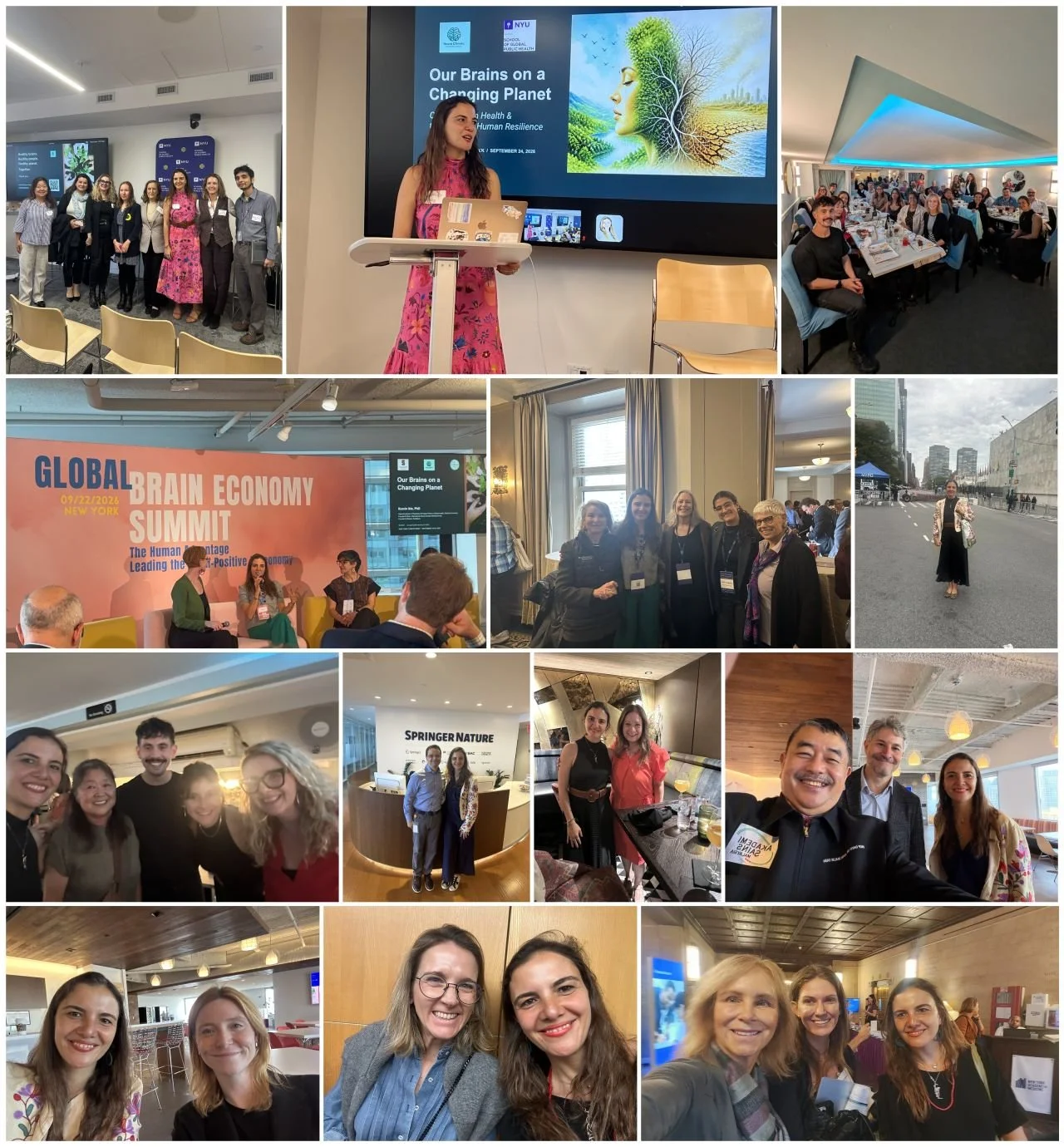
For two years, the Neuro Climate Working Group (NCWG) has been bringing together people across disciplines, countries, and time zones to ask a question that has been missing from much of the climate conversation: What does a changing planet mean for our brains, and what can we do to protect them?
At New York Climate Week, that community finally had the chance to gather in person. It was an extraordinary week of science, policy, new connections, and a little bit of disbelief at how far this shared effort has come. A week that brought brain health into new conversations
Our time in New York was about much more than a single event. On September 22, we joined conversations at Yale's Climate Week program, Healthy Planet, Healthy Minds and Brains, focused on what cities, health systems, universities, and communities can do with the evidence connecting climate change and brain health. The same day, we spoke at the Global Brain Economy Summit, bringing climate and environmental exposures into discussions of brain capital and the future of our economies.
On September 23, the conversation moved into architecture and design. At the Center for Architecture's Regenerative Design: Embracing a New-Old Mindset gathering, we joined the Brain-Body-Biosphere panel with Jessica Kronstadt of the Planetary Health Alliance and architect Suchi Reddy, exploring how buildings, public spaces, nature, and policy shape both human and planetary health. During the week, we also joined discussions with health ministers at the United Nations, including why communities affected by climate disasters need sustained mental and neurological health support long after the immediate emergency has passed.
Each of these rooms brought a different set of people to the table. That was the point. Neuroscience has something important to contribute to climate policy, public health, architecture, and economic planning, and just as importantly, our field has much to learn from the people working in those spaces and from communities living with environmental change every day.
From online meetings to a room full of colleagues
One of the most moving moments came before our public event, when NCWG members, collaborators, and partners shared a dinner together. People who had known one another through Zoom windows, shared documents, and late-night emails could finally talk without an agenda, laugh, exchange stories, and get to know the people behind the work.
That may sound simple. But for a community built across more than 60 countries, it mattered. Science and advocacy need relationships, trust, generosity, and places where people feel that they belong. This week reminded us that collective care is part of how collective action becomes possible.
Our first in-person event: Our Brains on a Changing Planet
On September 24, NCWG hosted Our Brains on a Changing Planet: Climate, Brain Health & the Future of Human Resilience at the NYU School of Global Public Health, our first in-person public gathering and the New York launch of our Neuro Climate Science & Policy Report.
The response exceeded what we had imagined. Our organizing figures recorded approximately 120 registrations and roughly 200 people on the waitlist, for a room seating only about 50–60. The demand was a powerful sign that scientists, health professionals, community members, students, and policymakers were ready for this conversation.
The morning began with a welcome from Mark Jit of NYU and an introduction from Burcin Ikiz, followed by a keynote from Frederica Perera of Columbia University on air pollution, climate change, and children's developing brains. Our first panel, A Brain Under Pressure, was moderated by Cecilia Sorensen and brought together Josefina Cruzat, Özge Karadağ, Swathi Manchikanti, and Yoko Nomura to examine emerging evidence, vulnerabilities, and research gaps across the life course.
Diane Ré introduced the international Brain-CLIMA research collaboration, and the second panel, Healthy Brains on a Healthy Planet, moved toward solutions. Moderated by Julianna Gwiszcz, it featured Sheryl Batchelor, Gary Belkin, Manasi Kumar, and Cláudia Santos, bringing Indigenous knowledge, community resilience, public mental health, and global perspectives into the conversation. Leyla McCurdy and Clayton Aldern guided the audience discussion, where questions turned toward what research, institutions, communities, and policymakers can actually do.
We left with a clearer sense of our shared task. It is not enough to document how heat, air pollution, disasters, and environmental disruption affect our brains. We must also build healthier environments, strengthen local resilience, support people with lived experience, and translate evidence into action.
Watch the full event recording · Explore the program and speakers
Why this week felt so special
After the event, a scientist colleague who had spent years working in neurobiology shared that the gathering made her feel “like I am part of a whole for the first time in my career.” Her words stayed with us. Many of us entered neuroscience because we wanted to understand and improve people's lives, yet the work can sometimes feel far removed from the communities we hope to serve. NCWG offers a way to connect that original purpose to the world outside our individual disciplines—and to one another.
We are deeply grateful to NYU School of Global Public Health for hosting us, and to the Global Consortium on Climate and Health Education, Billion Minds Institute, George Mason University Institute for a Sustainable Earth, and Medical Society Consortium on Climate and Health for helping make the event possible. Thank you to every speaker, moderator, report contributor, volunteer, partner, member, and participant who brought their knowledge and care to New York.
Where we go from here
Our September gathering was a beginning, not a finish line. We are carrying the momentum into the dissemination of the new report, research collaborations such as Brain-CLIMA, practical policy engagement, continued monthly global meetings, and the work of our Youth Council. Next comes COP31, where we will bring brain health into climate discussions alongside colleagues and partners from around the world.
We hope the lasting legacy of New York Climate Week is a stronger, more connected community: one in which different kinds of knowledge meet, people feel supported, and evidence leads to collective action.
Healthy brains. Healthy people. Healthy planet. Together.
Explore the NCWG report, resources, and ways to join our community.